For decades, EssilorLuxottica has stood as the undisputed titan of the global eyewear industry. Born from the merger of lens innovator Essilor and fashion powerhouse Luxottica, the company commands an ecosystem spanning lens technology, frame manufacturing, retail chains, and iconic brands. Its dominance once seemed unassailable.
Yet even giants stumble when technology rewrites the rules.
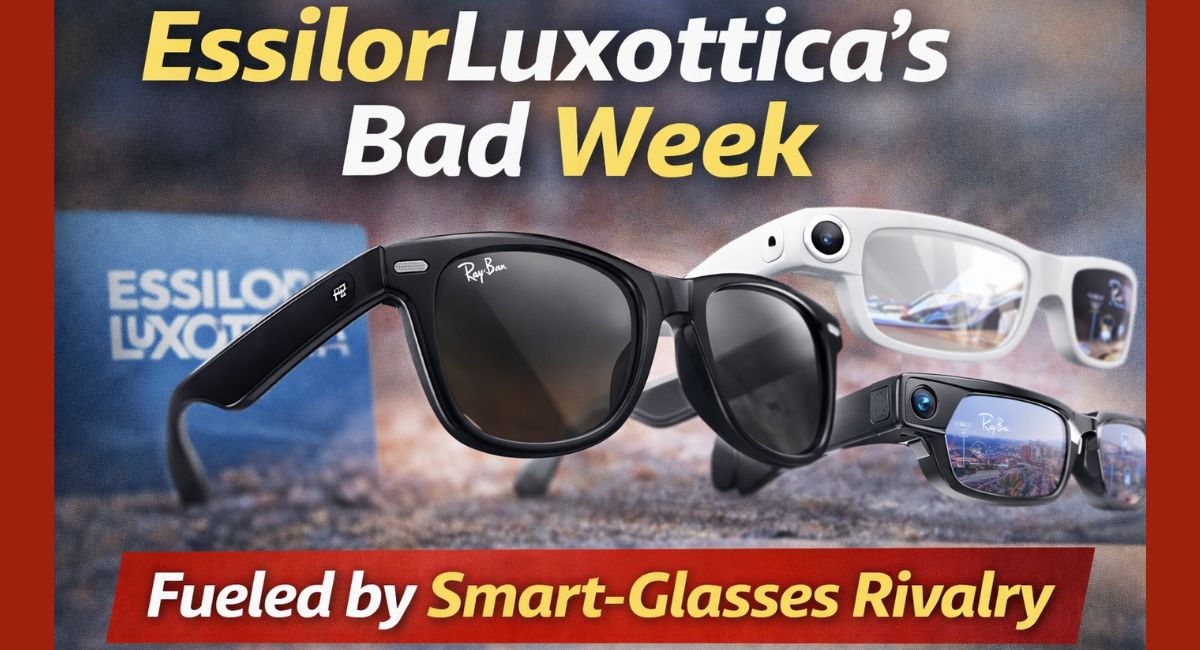
In a week marked by market jitters, competitive announcements, and shifting investor sentiment, the company found itself caught in the crosswinds of a rapidly escalating smart-glasses rivalry. What was once a niche experiment is now shaping up to be the next major computing platform — and every major tech player wants in.
This is not merely a product battle. It is a struggle to define how humans will interact with digital information in everyday life.
Why Smart-Glasses Suddenly Matter So Much?
The concept of smart-glasses has existed for years, but early attempts were clunky, expensive, and socially awkward. Today’s versions are radically different — sleeker, lighter, and powered by artificial intelligence, advanced sensors, and always-connected ecosystems.
Several factors explain why the category is heating up now:
1. AI Integration Has Matured
Voice assistants and on-device AI now make glasses genuinely useful — translating languages, summarizing notifications, guiding navigation, and even recognizing objects in real time.
2. Component Miniaturization
Cameras, speakers, batteries, and processors have shrunk enough to fit into frames that look like ordinary eyewear.
3. Consumer Readiness
After years of smartphones, earbuds, and smartwatches, consumers are comfortable wearing technology on their bodies.
4. Platform Ambitions
Tech companies see smart-glasses as a potential successor — or at least a companion — to the smartphone.
For a company rooted in traditional optics, this shift is both an opportunity and a threat.
The Rivalry Intensifies
The competitive pressure surged as technology companies accelerated their wearable strategies.
Partnership-driven products have already shown that fashion credibility plus tech innovation can be a powerful combination. Meanwhile, rivals are exploring independent hardware ecosystems that could bypass traditional eyewear leaders entirely.
Key players shaping the battlefield include:
- Meta Platforms — pushing AI-enabled wearable devices
- Apple — rumored to be developing lightweight AR glasses
- Google — revisiting wearable displays with new AI capabilities
- Samsung Electronics — investing heavily in extended-reality hardware
Each entrant brings software ecosystems, developer communities, and billions in R&D — advantages traditional eyewear firms cannot easily match.
How the Conflict Affected EssilorLuxottica?
The difficult week was not about a single event. It was a convergence of pressures:
Investor Anxiety
Markets respond quickly to disruption. As new competitors signaled aggressive plans, concerns arose about whether the eyewear giant could maintain control of its category.
Strategic Questions
Would the company remain a manufacturing partner for tech firms, or would it attempt to build its own digital platform?
Margin Pressures
Smart devices often carry different cost structures than traditional frames and lenses.
Brand Risk
If technology companies dominate the narrative, eyewear brands risk being seen merely as accessories rather than innovation leaders.
The company’s challenge is clear: evolve from a product manufacturer into a technology collaborator — without losing its identity.
Inside Modern Smart-Glasses: Key Specifications That Matter
Understanding the rivalry requires understanding the technology itself. Today’s smart-glasses combine multiple systems into a device that must remain comfortable enough for all-day wear.
Core Hardware Specs
Display Technology
- Micro-LED or waveguide displays
- Monocular or binocular projection
- Transparent overlays for augmented reality
Camera System
- Typically 5MP to 12MP sensors
- Ultra-wide lenses for first-person capture
- Privacy indicators (LED alerts)
Audio
- Open-ear directional speakers
- Beamforming microphones for calls and voice commands
Connectivity
- Bluetooth 5.x
- Wi-Fi support for cloud features
- Smartphone pairing
Battery
- 4 to 8 hours active use
- Charging cases in some models
Sensors
- Accelerometer
- Gyroscope
- Ambient light sensor
- Touch controls on the frame
Software and AI Features
- Voice assistant integration
- Real-time translation
- Navigation prompts
- Photo and video capture
- Livestream capability
- Object recognition
- Notification summaries
The most advanced models aim to deliver context-aware computing — information appearing precisely when needed.
Fashion Meets Function: The Design Challenge
Unlike smartphones, glasses sit directly on the face. That makes aesthetics critical.
EssilorLuxottica’s historical advantage lies here. Its portfolio includes luxury, sports, and lifestyle brands, giving it deep insight into consumer tastes, fit, and durability.
Technology companies, by contrast, often prioritize engineering over style.
The winning formula likely requires both:
Fashion credibility + seamless technology + everyday practicality
Without all three, adoption stalls.
Partnership Strategy vs. Platform Control
One of the central strategic dilemmas is whether eyewear companies should:
Option A: Partner With Tech Firms
Pros:
- Access to software ecosystems
- Reduced R&D risk
- Faster time to market
Cons:
- Limited control
- Dependency on partners
- Lower long-term margins
Option B: Build Independent Technology
Pros:
- Full ecosystem control
- Higher potential value
- Brand leadership
Cons:
- Massive investment required
- High technical complexity
- Risk of failure
The rivalry intensified because competitors are pursuing both paths simultaneously.
Consumer Use Cases Driving Adoption
For smart-glasses to succeed, they must solve real problems.
Everyday Convenience
Hands-free communication, navigation, and reminders.
Content Creation
First-person photography and livestreaming appeal to social media users.
Accessibility
Real-time captions and visual assistance can help people with hearing or vision challenges.
Professional Applications
Field technicians, medical staff, and logistics workers benefit from heads-up data.
Travel and Language
Instant translation could transform international experiences.
As these use cases expand, demand will grow — and competition will intensify.
Privacy and Social Acceptance
No discussion of smart-glasses is complete without addressing privacy concerns.
Early wearable cameras faced backlash due to fears of covert recording. Modern devices attempt to address this through:
- Visible recording indicators
- Physical camera shutters
- Clear consent features
Social norms will evolve, but companies must tread carefully.
Trust will determine adoption as much as technology.
The Stakes for the Future of Computing
Industry analysts increasingly believe that wearable displays could become the next major platform after smartphones.
If that happens, control of smart-glasses ecosystems could reshape the tech hierarchy.
For EssilorLuxottica, the stakes are existential:
Remain a supplier in someone else’s platform — or become a co-architect of the next computing era.
Can the Eyewear Leader Turn Pressure Into Advantage?
Despite the turbulent week, the company holds powerful assets:
Global Distribution
Retail stores, optical chains, and partnerships worldwide.
Lens Expertise
Prescription integration is a major barrier for tech companies alone.
Brand Trust
Consumers already rely on the company for vision care.
Manufacturing Scale
Mass production capability reduces costs.
If leveraged effectively, these strengths could transform rivalry into opportunity.
What Comes Next in the Smart-Glasses War?
Several developments are likely in the coming years:
- AI-first wearable assistants
- Lightweight augmented reality displays
- Prescription-ready designs
- All-day battery life
- Seamless cloud integration
The ultimate goal: glasses that feel indistinguishable from normal eyewear while functioning as intelligent companions.
The company that achieves this balance will define the category.
EssilorLuxottica’s difficult week reflects a broader truth: industries built on physical products must adapt when software-driven innovation arrives.
The smart-glasses revolution is not just about gadgets. It is about merging vision, computing, and daily life into a single seamless experience.
For consumers, the outcome promises unprecedented convenience.
For companies, it is a high-stakes race to shape the future of human-technology interaction.
And for the eyewear giant at the center of the storm, the rivalry may ultimately prove to be the catalyst that pushes it into its most transformative era yet.
FAQs
What are smart-glasses used for?
Smart-glasses provide hands-free access to digital information, including navigation, calls, photography, translation, and augmented reality overlays.
Do smart-glasses require a smartphone?
Most current models pair with smartphones for connectivity, though future versions aim to operate more independently.
Can smart-glasses replace smartphones?
Not yet. They are currently companions to phones, but advances in AI and cloud computing could reduce reliance on handheld devices over time.
Are smart-glasses safe for eyes?
Reputable manufacturers design displays to minimize strain, but users should follow recommended usage guidelines, especially for extended wear.